With the slew of modern games mostly revolving around beating ten tonnes of shite out of something, someone or even each other, it’s refreshing to know that we do have a few alternatives. The kind of games for those off-days where we feel like slipping in to a hypnotic coma and waking up to a repetition of colourful lights and custom music. Meditative gaming (although not strictly a recognised genre yet) is an aspect of gaming that I have been rather enthused about on and off for a long time now. Coincidentally, the frequency of such experiences always creep up on me, unawares, in much the same way as the hypnotic states they induce, such as a daydream or hallucinogenic drug that suddenly catches you off guard. Subconsciously I’m drawn in, suddenly immersed, and before I know it, the dinner that I so carefully prepared and put in to the oven three hours ago has now burnt in to a lump of coal and firemen are breaking down my door while I remain oblivious to the rest of the outside world.
Meditative games usually involve: repetition (but not in a way that is boring or even consciously acknowledged), a constant focus on one element of the game, colourful and abstract visuals and, moody music (which can often be exchanged for your own custom music depending on the game in question).
So, what are examples of meditative games? Well, I’ve put together a few here. I’m sure there are plenty more and probably a few I’ve missed but anyway, here goes.
Every Extend Extra Extreme: a rather long winded title, and the kind of title that we see bandied around a lot these days with developers poking fun at the old school arcade and console titles of the 80s. Today we have titles such as Super Meat Boy, PowerUp Forever or the more controversial: Super Columbine Massacre RPG! If the trend continues I’m sure we can expect titles in the future lavished with just as many superlatives; Super Knitting Fanatic Turbo Edition or Extreme Granny Bandit 5000 as a couple of examples.
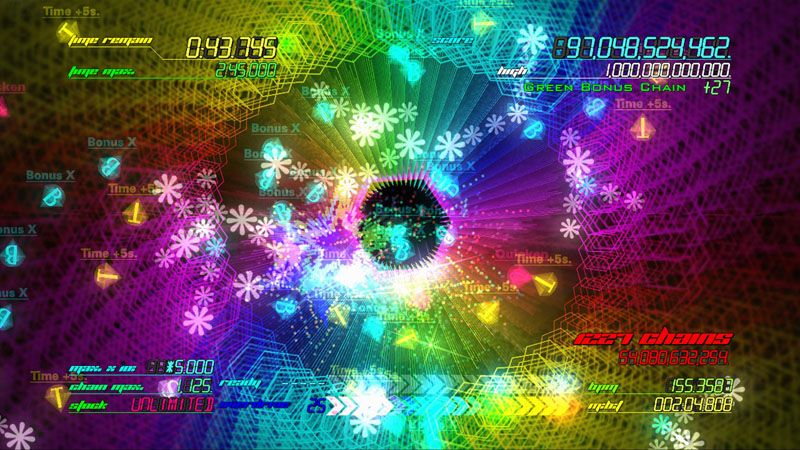
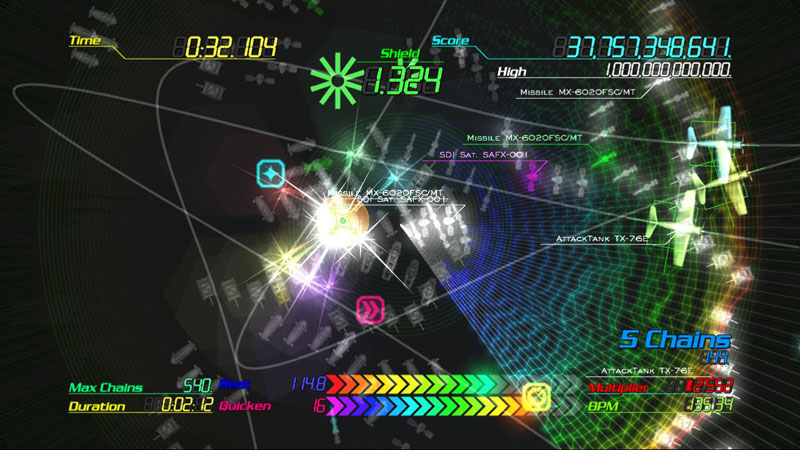
But let’s just call it E4 for now. E4 involves moving a small ship around the screen which is filled with moving shapes. When the time is right you can detonate your ship causing a chain reaction that detonates all the little shapes around it. When this happens each detonated shape provides an extra beat or layered element to the music. The process is repeated and if you can keep the chain reaction going, the beats keep coming, building in to a cacophony of blissful electronica. Get hit by one of the shapes and your ship is destroyed at which point the music dips to the basic melody you started with. The effect of breaking the chain can be quite sudden and removes you from your previous trance-like state, bringing your conscious self back to reality.
Then there’s AudioSurf, a game that generates a virtual highway based on a music track of your choice. This virtual road that you ride down undulates and accelerates according to the structure of the track you’re playing. On the way, hit the coloured blocks scattered along the three highway lanes and avoid the grey ones. The blocks provide a certain focal point which draws your whole attention in to the game.
In AudioSurf, you’re not just listening to the music but you ARE the music, moving with the ebb and flow of the melody, responding to every beat, every jump in tempo and timbre. As such, the immersion and focus on the symbiosis between music and game is pretty captivating.
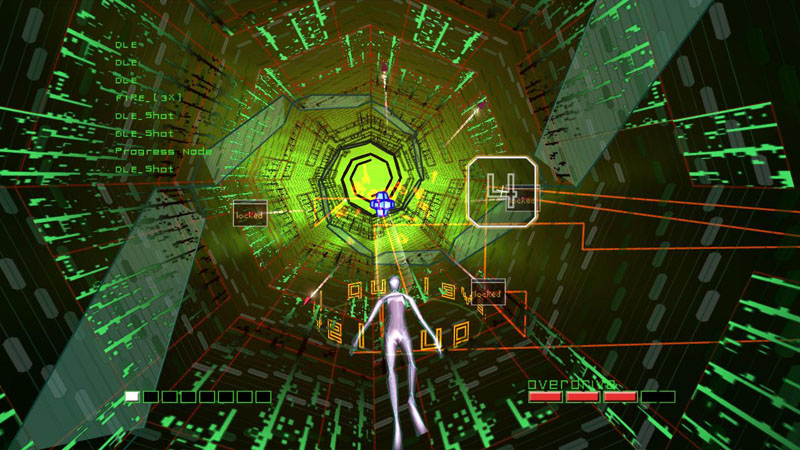
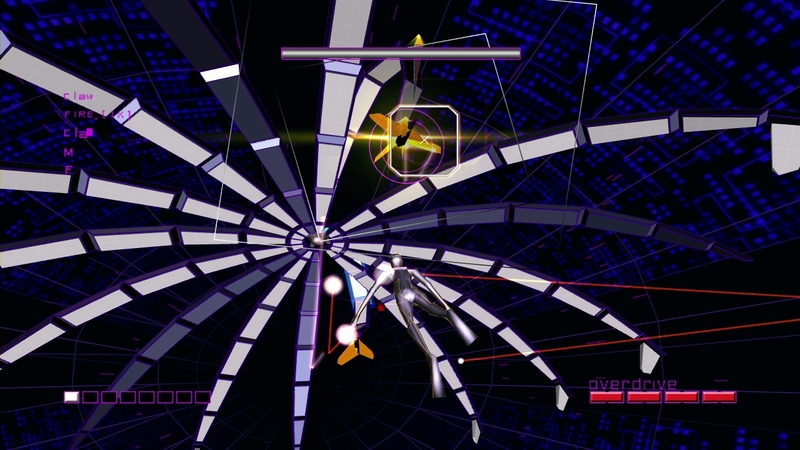
Rez is also worth a mention. The original game on Playstation 2 and Dreamcast pays homage to the Russian painter Wassily Kandinsky. As one of the founders of abstract art, Kandinsky’s work not only inspired the visual style of the game but also the name of the virtual world the player inhabits: The K-Project.
Flying gracefully through cyberspace, the timing of your targeted destruction of the viruses inside K-Project provides a layered beat to the music in a similar fashion to E4. The hypnotic visuals and connection between your own interactions and the musical score make it an experience not dissimilar to watching Tron after drinking a pint of battery acid.
It’s evident that a lot of these games utilise music as an important aspect of their mechanics. Rez in particular was designed to induce synesthesia, a state of mind where two separate cognitive functions mesh to form one whole experience. In the case of Rez this was of course the interaction between the AI and its connection to the music.
flOw and Flower: two Playstation 3 games released through the PS3’s PSN network. Both created by the independent American developerthatgamecompany (or TGC for short) they are an attempt to tap in to an emotional experience unseen in most games and make this experience accessible to a broad range of players. Both games are probably more akin to relaxing meditative experiences than hypnotic ones. If Rez and E4 are cosmic acid trips then flOw and Flower are lovely, steamy bubble baths.
flOw involves guiding a microscopic-like organism around an eerie vacant ocean. Your creature (if we can call it that) can consume smaller organisms and in doing so evolves its structure before diving deeper down in to the ocean to face bigger and more complex creatures. Evolution is a strong theme throughout and is quite similar to Spore’s initial cell stage.
Flower is the spiritual successor to flOw and is meant to induce an emotional experience of relaxation and contentment. Controlling the wind, you guide a single flower petal across a dark foreboding landscape bringing colour and life to the world. There is no written narrative and it shuns many of the features that are so common in games: no lives, no points and no losing; it exists simply to evoke positive feelings.
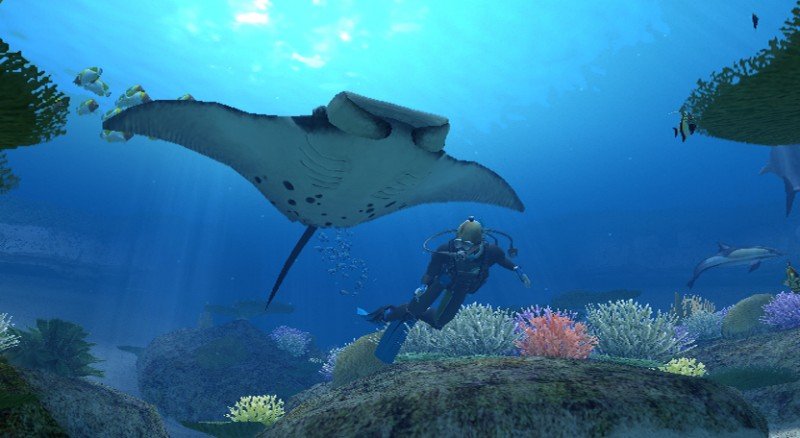
Like Flower, Endless Ocean on Wii does away with the traditional aspects of videogame culture and gives us a free-roaming relaxing experience as a scuba diver in the depths of an ocean. There is no stress and no resistance, no enemies and no game-over. You simply explore the depths of the ocean discovering sunken treasure and photographing various fish to your heart’s content. The game also allows the use of custom music so you can swim along happily to your own personal soundtrack. While for some it may sound as exciting as a day trip to Swindon, for others it can provide an immersive tranquil experience and a fresh alternative to the grinding gears of war and constant calls to duty that we are so often bombarded with.
Wipeout (series): the first game in the series brought the original Playstation in to the media spotlight and became one of the most popular first release games on the system. As a futuristic racing game, players glide around the gutter-like tracks at high speed using various power-ups to take advantage of their opponents. Part of the popularity of the series can be attributed to the soundtracks which featured some of the best electronic artists of the time: The Future Sound of London, The Chemical Brothers, Orbital, Fluke, Underworld, Photek, Leftfield, Daft Punk, Source Direct(whose track 2097 was created specifically for Wipeout 2097) and The Prodigy. This popular mix of artists also prompted Ministry of Sound nightclub in London to install their own Playstation with a playable version of the game available to clubbers.
First time players may find the game a little taxing and would probably frustratingly bash in to the wall of every curve, like some mad, alcoholic Han Solo. However, once a player has mastered the art of silkily gliding round corners, keeping a constant steady flow around the track, the result is a toxic mix of focussed hypnosis and euphoria over your new found finesse.
So there it is really, a mix of some of the best mind blowing, mescaline fuelled trip-out games. Try playing these at night with the lights out for the ultimate in mind-bending hypnotic gaming.
It’s worth pointing out that this article was originally written in 2007 for an essay as part of my Computer Game Design degree at Teesside University, and so obviously it’s a little dated now. Nonetheless, it’s interesting to see where virtual economies have actually come since then.
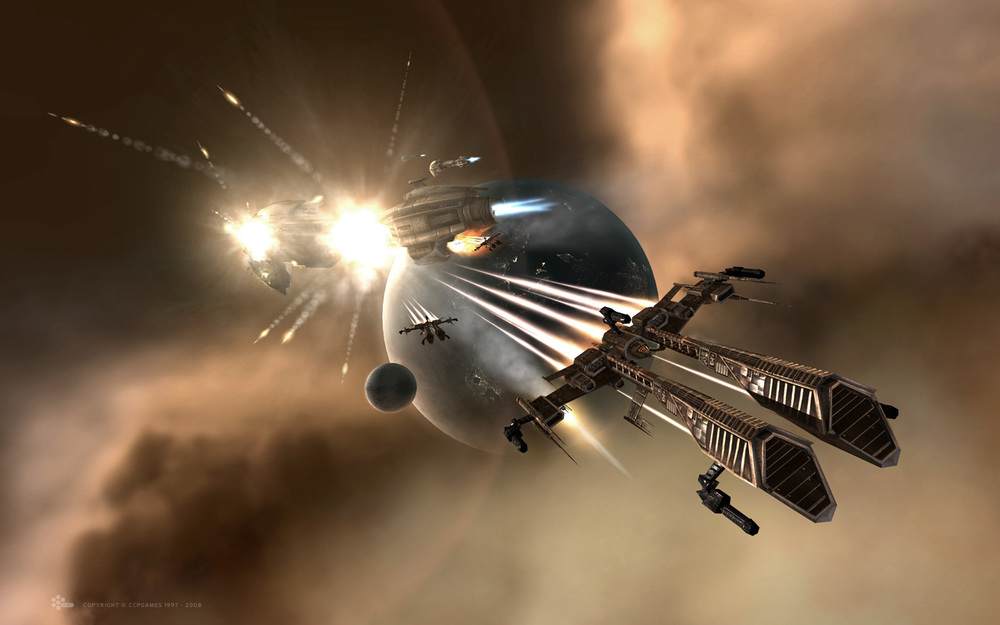
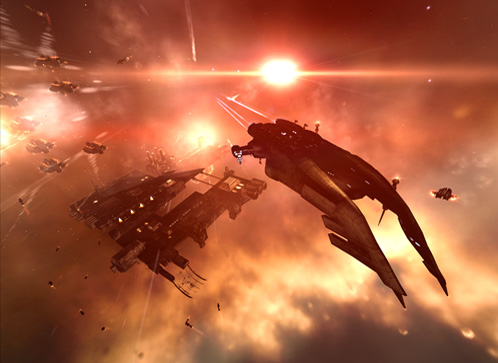
In 2006, a self-proclaimed investment banker walked away with 120,000 US dollars that did not rightfully belong to him. This money had been invested by clients of the bank under the assumption that it would accrue interest; it did not. Instead, the owner of the bank waited until there was a sufficient amount to satisfy his needs, took the money, and ran. Interestingly, the banker’s actions were completely legal, no crime had been committed. The authorities did not get involved, and nobody even reported the incident to the police. The bank in question was in fact, part of an online virtual world known as EVE-Online and although the money was virtual, it had a real world value of 120,000 US dollars. The practice of selling virtual assets has become commonplace now, particularly in massively multiplayer online role-playing games, (or MMORPGs). Although most companies now condemn the practice – claiming that any assets in a game they produce are their property and therefore a user has no right to sell them – many people still sell virtual currency and high level characters on sites such as e-Bay.
The field of MMORPGs is a relatively new one, and the field of virtual economies within these games is even more recent. However, there are still a number of scholars, writers and journalists that have contributed to the field of MMORPGs and the virtual economies that thrive on them. Edward Castronova is a leading figure on the subject and wrote Synthetic Worlds: The Business and Culture of Online Games. He has also written several papers on the subject of virtual worlds and virtual economies. Julian Dibbell has published works on his own experiences as an MMORPG addict as well as personal investigations in to virtual economies with Play Money: Or, How I Quit My Day Job and Made Millions Trading Virtual Loot. Dibbell also runs a regular blog on his website, often documenting his latest findings and theories on the world of MMORPGs. Virtual-Economy.org holds a wealth of information, including the latest news stories on virtual economies and links to journals and articles written by experts in the field. R.V. Kelly offers some interesting insight in to the culture and players of virtual worlds such as MMORPGs and documents his theories on the addictiveness of such games. Kelly’s book explains the appeal of MMORPGs both from a personal standpoint and an external one by researching the activities of other players. Most relevant of all, Kelly offers his opinions on what will be the future of MMORPGs and how the market will evolve with them.
There are various news stories that also inspired this article. Scandals both online and offline have grown considerably with the likes of the popular game World of Warcraft, Everquest and Lineage 2. Online media articles and websites such as The Inquirer, TIME and Asian news sites document stories of violence, death, addiction and legal battles involving MMORPGs. Peter Vorderer’s and Jennings Bryant’s Playing Video Games, documents interesting research on the social side of MMORPGs, it also includes some interesting statistics on subscriber populations and player demographics. Playing Video Games explains some characteristics of MMORPGs that give a greater understanding of how and why virtual economies have come to flourish.
Stories such as the EVE-Online scandal that opened this article, have given an understanding of a world that is separate from our own existence and yet contains many of the same hardships and joys that we find in reality. Reading some of these stories gives a greater understanding of how players can become so immersed in these worlds that reality has become more of an illusion for them, because the game world is their life. These varying sources offer an interesting and unbiased opinion on the issue of virtual economies. Understanding the field of MMORPGs through direct experience, aids in the understanding of what motivates people to trade virtual assets through real world channels. Personal experience with games such as World of Warcraft, Lord of the Rings Online, EVE- Online and more serious examples such as Second Life, helps to understand a new culture of videogames that is beginning to blur the lines between fantasy and reality.
The Future of Virtual Economies and MMORPGs
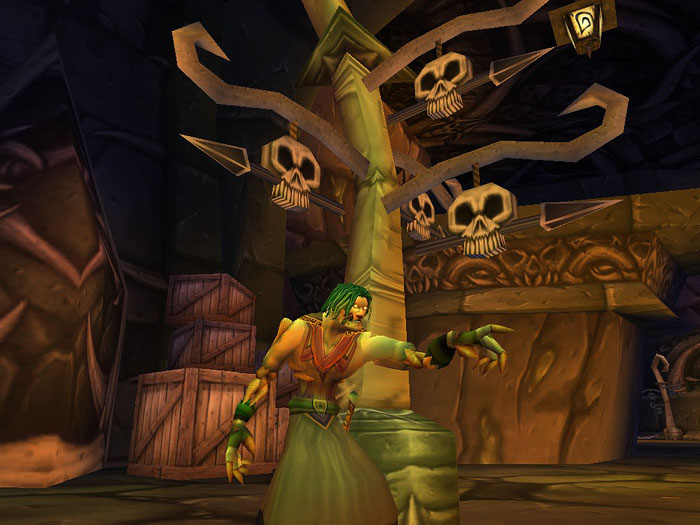
MMORPGs have seen rapid growth in the last ten years. World of Warcraft now has over seven million subscribers making it a tough contender for most other MMORPGs. (Harper, E. 2006)
What is it that makes these games so popular? Some feel that it is the social side of the game that makes them so appealing, the ability to talk to and interact with thousands of other players in the same world. Others enjoy the escapism of becoming another person in a fantasy world, able to get away from their ordinary lives and become someone else. For some, however, it is the feeling of increasing power that drives them to play more. Part of the gameplay of an MMORPG involves increasing a character’s ‘level’ which makes that character more powerful and able to take on unique abilities unattainable by lower level players. Various other factors also work to increase the power of a player’s character including buying advanced equipment and extra skills. Not only that, but most MMORPGs never end for a player. Even when a player has reached the maximum level attainable for his/her character there is always better equipment to buy and new assets to be obtained. Because the game is always based online, the developers of the game often add new areas, items and quests to keep players who feel they have exhausted the game, busy.
Players of MMORPGs like to feel powerful. But power in an MMORPG usually comes with a price, and that price is time. It can take months to develop a character in an MMORPG to superhuman standards, and this is assuming that the player plays the game on quite a regular basis. All the time and effort players put in to developing their characters is almost like a full time job. Some players spend more time playing an MMORPG than they do at work. Kelly, R.V. even states that:
‘obsessed players spend every night, every weekend, every vacation – for years at a time, forgoing sleep, food and real human companionship just to experience more time in the virtual world.’ (Kelly, R.V. 2004)
Over the years, players have struck on the idea of selling their virtual characters together with the virtual equipment and virtual money for cold, hard, cash. This practice has become popular, as many players are willing to pay large sums of real money to own and control a high level character in a virtual world without going through the months of arduous training and questing in order to reach those pinnacles of virtual success. People are willing to pay because they want power; they want to feel superior to other players without spending all the time and effort that goes in to achieving it. Some people have actually formed companies which hire staff to play MMORPGs for hours at a time and then sell the acquired characters, assets and virtual money on websites such as e-Bay. Developers of the MMORPGs, however, started to become aware of this practice and Sony was the first company to ban player accounts that were selling virtual goods from the popular MMORPG Everquest through online auction sites. (Kelly, R.V. 2004, p15) Many developers claim that all assets within their game are the intellectual property of their company and therefore cannot be sold on by third parties. This reduced the amount of online sales of virtual goods considerably but there were still some that opposed the companies’ new legislations.
Perhaps one of the best examples of this is the story of Blacksnow Interactive. Blacksnow Interactive was a company set up in 2006 that traded in virtual goods from MMORPGs such as Dark Age of Camelot and sold them through online auction sites. Mythic Entertainment, the developers of Dark Age of Camelot tried to prevent Blacksnow Interactive from continuing trade of virtual goods. In response, Blacksnow Interactive filed a lawsuit against Mythic under ‘various anti-trust, copyright and anti-competitive issues.’ (Bishop S. 2002) Blacksnow Interactive claims that they are simply dealing in ‘time’. Blackstone’s director also stated:
‘What it comes down to is, does a MMORPG player have rights to his time, or does Mythic own that player’s time? It is unfair of Mythic to stop those who wish to sell their items, currency or even their own accounts, which were created with their own time. Mythic, in my opinion, and hopefully the court’s, does not have the copyright ownership to regulate what a player does with his or her own time or to determine how much that time is worth on the free market.’ (Eurogamer, 2002)
So where does this leave the question of allowing virtual trading, now and for the future? Some companies have actually embraced virtual trading and designed their games around it. Sony actually created an online store through which players could trade items from the game Everquest 2 in a complete turnaround to their stance on the trade of virtual goods in Everquest 1. An MMOG called There involves players buying their own equipment and weapons for real currency. Any items they acquire through playing the game can then be sold legally. Second Life from Linden Labs is a game that allows players to create in-game items and environment pieces with some basic programming knowledge and then sell those items to players. Any virtual money that is earned in Second Life, (the currency being Linden Dollars), can then be exchanged on a Linden Labs website for real US dollars. Linden Labs have their own exchange rate for Linden Dollars and some people actually earn a very profitable living simply through setting up businesses in Second Life’s virtual world and treating it like a full time job.
This information begs the question, should we embrace virtual trading or should companies protect their assets? What about the dangers of trading virtual commodities? Because of the value of virtual goods now, disputes surrounding them are often brought in to the real world. In 2005, Qiu Chengwei, a Chinese player of the popular online game Legend of Mir 3 stabbed Zhu Caoyuan, a fellow player to death over a sword that Qiu had lent to Zhu. Zhu had apparently sold the sword for the equivalent of £473 after borrowing it from Qiu. Qiu tried to take his case of the stolen sword to the authorities but there is no system set up in China to deal with online incidents such as these. (BBC NEWS, 2005) Korea, on the other hand, has such a massive online gaming community that the police have a special department to deal with online crimes. Second Life and The Sims Onlinehave housed gangsters in their virtual worlds willing to do the dirty work of any other online resident for the right price. When people realised there was some serious money to be made within these virtual worlds, corruption started to spread. In EVE-Online, players have set up mercenary corporations to assassinate and loot the corporations of other players. This is completely legal within the game, but when virtual items start acquiring a real-world value, victims of such attacks may look for revenge outside the game world.
We are entering a new age in the world of online gaming where virtual worlds are hotbeds for real world trade. When investigating Edward Castronova’s findings on the value of internet goods sold from Everquest, Kelly, R.V. states that:
‘the game’s per capita GDP made the virtual country of Norrath the 77th largest economy in the world – somewhere between the economies of Russia and Bulgaria’ (Kelly, R.V. 2004)
This is impressive for a nation that doesn’t actually exist in the real world.
So what is the future of virtual trading? By making the items legal, many players may ruthlessly fight over virtual goods, possibly even bringing their confrontations in to the real world, as Qiu Chengwei did. If the companies prohibit the trade of virtual commodities, the trade may develop a black market for such goods with no regulation or control. One solution to this problem, suggested by various scholars and websites, is for governments to tax the assets of virtual worlds.
In the case of the EVE-Online banker who swindled 120,000 US dollars worth of virtual money, some players believe he should be taxed on his loot. However, Edward Castronova often argues against the taxation of virtual worlds, stating in The Right to Play:
‘The art that once framed an immersive imaginary experience will be retracted back to the walls of the space, and the people will go back to looking at it rather than living it.’ (Castronova, 2004)
I, for one, agree with Castronova. Taxation is a little over the top, and, as he implies, games will lose their fun. They will simply become markets for businessmen and those who wish to corrupt the system. Virtual worlds such as EVE-Online and World of Warcraft are not meant to be markets, they are meant to be games. Taxing players on virtual commodities in games will take away the original dream that belonged to the developer and forcibly turn their worlds in to virtual markets.
One alternative would be for developers to impose tighter restrictions on the way their goods are exchanged within the game. Currently, many players, (depending on the game), have the ability to transfer characters to another player quite easily. If these features were analysed and controlled, it could reduce the amount of virtual trafficking throughout their worlds. Unfortunately, assets such as in-game currency can not be so easily controlled without breaking some essential gameplay elements. The trade of goods and currency is a particular trait of a lot of MMORPGs and one that uses the device of familiarity to more deeply immerse a player in the world. By forcing the developers to impose restrictions on their games, the gameplay may suffer as a result. The familiarity of the real world is one of the traits of an MMORPG that makes it so immersive. Unfortunately, the real world has its fair share of problems, and once those problems migrate from the virtual world to the real world, (as in the case of Qiu Chengwei), problems can occur.
In my opinion, governments and authorities will not step in to the virtual worlds for a long time to come. The market for virtual goods has been slowed by the introduction of new rules in most MMORPGs prohibiting players selling virtual goods online and the banning of players caught violating these rules. I predict that as the games industry matures, so will its players, and these players will not wish to ‘buy’ their way in to a game. They will prefer instead, to play the game as it should be played. After all, it defeats the point of the game if you buy a high level character with high level equipment without going through the process of earning it the way the game intended. Players who do buy their way in to high level characters and equipment would most probably find themselves at a loss against other players who worked their way up in the proper manner because they lack the knowledge and experience of the game to be able to use their characters skilfully. However, in the case of games such as Second Life, this does not apply, as the game is not based on levelling characters and acquiring great weapons, but is more of a simulation and a business environment. Though with Second Life, Linden Labs allows and controls the virtual currency of the world.
Second Life and games similar to it are certainly interesting in terms of their business model and may well flourish in the future, as long as the users behave themselves. Virtual markets for these types of virtual worlds may well become something that reaches a wider audience in the future. However, as far as games are concerned, I do not believe that the market for in-game items and characters will grow substantially in the future. I believe that in the future, many more gamers will wish to play these games as they should be played, rather than cheat, by paying money to advance their character.













 Simon Halliday